Showing posts with label colors. Show all posts

Thursday, September 26, 2013

A more classical anti-ad sign


Making a "no ads please" sign from Hama beads. This time, I'm trying out a more elegant and old-fashioned type design, with muted warms colors. This is the one I made for our own door.

The text is 20 Reddish Brown and the background is 21 Light Brown. I also put a frame with the "gold" color, not that that really showed in the final stage.


Thursday, September 19, 2013

Beads with Flowing Stripes


Experimenting with striped patterns in polymer clay. I wanted a natural wavy look that would continue across the beads.

For the base, I used a somewhat translucent dark gray. The gray is mixed from 1 part translucent 'white' (unpigmented) Fimo Soft polymer clay, and 1/32th black Fimo Soft. The stripes are plain white Fimo.


I made sheets of both colors, rolled on the second-thinnest setting on my pasta machine. A layer of white is sandwiched between two layers of gray. The sheet is then cut into four equally-sized pieces. These four pieces were then stacked, with a bit of scrunching in the middle, to create the wave. The edges are kept neat and unscrunched on purpose. The squares in the background are 1 cm.


I made a cylinder of the same gray color as the base, and cut that in half. The wavy stack goes in between the halves. Put together, this approximate cylinder is ready to be reduced! After reducing, I made some of the beads by putting thin slices on a gray base, and some simply by cutting thick slices from the cane (The results were quite similar)


Above, the beads before baking, and below, after baking and polishing.

Sunday, March 31, 2013

Masking & red cabbage dyeing Easter eggs

Easter eggs dyed with red cabbage

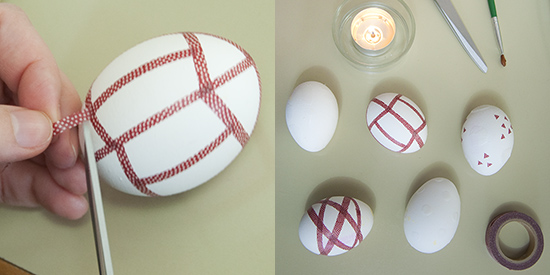
This year we colored Easter eggs with red cabbage juice. The patterns were made by masking the eggs with washi tape and candle wax.

Straining red cabbage

To extract the color from red cabbage, I boiled slices of five large leaves in water with some vinegar, for roughly 30 minutes, then removed the cabbage leaves by straining, and allowed the dye to cool. On the right is a piece of cotton string we boiled with the cabbage. It turned a very nice purple, I'm hoping the dye will stick to it.

Covering eggs with washi masking tape

To get patterns on the eggs, we covered some parts of them with washi masking tape. We also used molten candle wax, applied with a small paint brush.

Easter eggs soaking in red cabbage dye

The eggs were soaked in the cabbage dye for a few hours.

Dyed Easter eggs

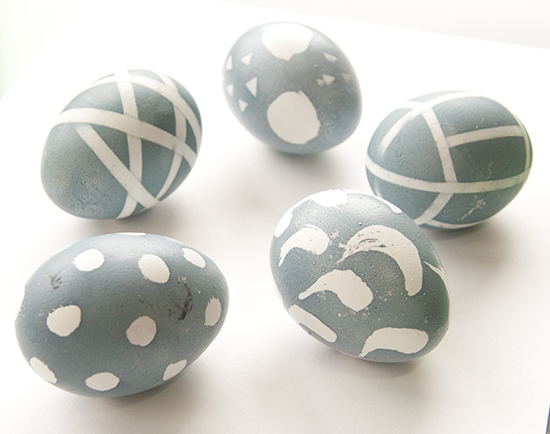
Rinsing and removing the masking tape. The color is a nice blue, even though the cabbage was red and the dye purple! Red cabbage juice works as a pH indicator; it turns red when acidic and blue in alkaline solutions (and can even turn green or yellow for strong alkalines). It seems there is some chemistry going on in the shells.

The masking tape worked well - it kept the dye off the masked parts of the egg. Where two stripes of tape crossed each other an unexpected effect appeared: the upper stripe did not mask the egg perfectly just where it passed the lower stripe, giving an illusion of depth in the final pattern! The lines on the egg that appears to pass below another line were created where the tape stripe passed above another stripe.

The painted-on candle wax gave nice artistic effects!

Dyed Easter eggs

The finished eggs. Happy Easter to everyone!

Thursday, March 7, 2013

Red Snail Missing


I recently found a box of my childhood favorite candy, the 'Frog butterfly snail' ones - every eighties kid from Finland knows which ones I mean.

As a kid, it was always important that the box contained at least one candy of each of the ultimate correct types: red butterfly, yellow snail, and green frog. I'm happy to report success in the present case! In fact, the only combination missing from the box I bought was a red snail.

Saturday, February 23, 2013

Mini lanterns on a LED series


I made a set of small paper lanterns for a LED light series we have on a wall (indoors!). The paper lanterns are stylish and easy to make - they are a standard type of origami called 'fusen', which means balloon. I learned about them from the book The Simple Art of Japanese Papercrafts by Mari Ono. These little cubes are inflated after folding, and the air hole was very convenient for putting the fusen on a LED lamp.


The ones I made for this project are quite small. I used 7.5x7.5 cm paper, and the side of the cube is always a quarter of the side of the paper you started with. Since the LEDs don't give off any heat, the small size is not a problem. The origami paper diffuses the light very nicely, and the colors of the papers show up very bright.

Best of all, the color scheme infinitely adjustable, just by adding and removing colors according to seasons, holidays and moods!

Saturday, February 16, 2013

A Pibow case!

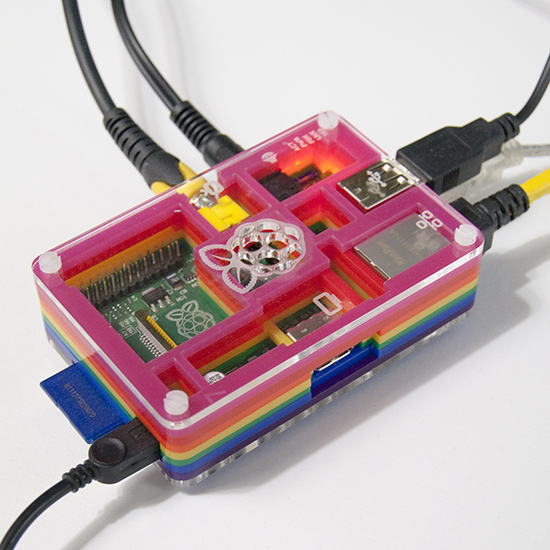
My Raspberry Pi in its new Pibow housing.
For Christmas I got a Pibow case. I like it very much! The Pi in the Pibow case feels nice and robust. The Pi gets slightly warmer in the case than without one, but this has not been a problem at all.

Thursday, February 14, 2013

Happy Valentine!


We wish you all a happy Valentine's day with origami hearts and an equation.

Let's make a plot in polar coordinates, of \( r = |\phi|^p\). The angle \(\phi\) goes from \(-\pi\) to \(\pi\),  and \(p \approx 1 \). Here is the plot, in processing, with \(\phi = 0 \) pointing up. Move the mouse to change \(p\)!

Mathworld has more equations for hearts, but none of them is as simple as ours. As \(p = 1\) gives a nice shape, \(p\) can be left out for an even simpler equation.


Monday, January 14, 2013

New Hama Anti-Ad Sign

Our previous 'no advertisements' sign proved so popular that it was actually stolen (or anyway, it disappeared, most likely it fell down and was cleaned away or something). So I made a new one.

The new sign is made with Hama beads, like the old one. The sign has 01 White text on a 17 Grey background. I also made a glow-in-the-dark frame, with 55 Glow-in-the-dark green and 57 Glow-in-the-dark blue. It looks quite nice, a pop of bright color in the dark hallway, but it was very difficult to photograph!

The text, "Ei mainoksia kiitos!", is Finnish for "No advertisements please".

Saturday, December 29, 2012

Color mixes for pastel beads


I wanted to make colored translucent beads from Fimo polymer clay. I think the ready-made colored 'translucent' Fimo is too strongly pigmented, and not so translucent. The idea here is to reduce the amount of pigment, by mixing in unpigmented (i. e. 'white') translucent polymer clay.

Unpigmented clay is very soft, almost too soft to form into beads with any precision. The unpigmented clay in the reddish-violet beads above on the left was a bit dry, which made it much easier to control. But when baking, the dry clay produced a lot more of whitish flakes or stripes you can see in the picture above. I don't mind so much though, it looks a bit like some kind of stone.

I played around a bit with mixing different colors with varying intensity and lightness, to get the shades I wanted. The glass beads in the picture below served as inspiration and goal, to keep the colors subtle and counteract the temptation to create super-bright shades.


It's impossible to get an accurate idea of the color of these low-pigmented mixes while actually mixing them. Unbaked (in the upper half of picture above) they look almost completely white, since they get translucent only during baking. That's why a color chart comes in handy!


To read the chart: '1 blue + 1 violet + 32 white' means that I mixed 1 part translucent blue, 1 part translucent violet, and 32 parts 'translucent white' (i.e. unpigmented) Fimo polymer clay. In practice, I used one stripe (one eight of a packet) of unpigmented clay, and one 32th of a stripe each of the blue and violet clays. So one part is here just a tiny amount - unless you want to end up with piles of pastel clay.

The conical turquoise beads are made with a bead roller, the other ones I formed by hand. They were all sanded and polished after baking.

For the brownish ones, I mixed in a bit of green, as you can see, to get the saturation down. The result it a bit too reddish for my taste. My favorites are the darker turquoise and the bluish violet. Most of these semitransparent pastel colors would probably look nice layered with opaque white!

Sunday, December 9, 2012

Iridescent frying pan


Our stainless steel frying pan with colorful patterns. Frying stuff in this pan is not particularly nice, since everything, including bacon, seems to stick unless I add lots of fat. The colors offer some consolation, though. I suspect these colors appear due to light interference in a thin film of oxide on the pan's surface.


This picture of a Bismuth crystal from Wikipedia
shows the same effect. The crystal is covered with a thin oxide layer. When light reflected from the top and bottom of the oxide layer interfere, the colors appear. I like the G-shaped growth patterns in this picture even more than the rainbow coloration.

Monday, November 5, 2012

Circle Stickers - Lots of Dots


One great thing about Germany is the abundance of small, inexpensive round paper stickers - supposed to be used for archiving, I guess, but in my experience, they're also great for super-fast artwork creation, and for arranging nicely on a table.


On a side note, this company has a very impressive sticker repertoire. I haven't yet seen a shop that would sell all of these, not even in Germany.

Sunday, October 21, 2012

Mixed Beads

Experimenting with colors while using up some old leftover Fimo polymer clay. I formed three piles of finely chopped clay, then mixed some of each color into the others. With some of the purple and blue, I re-chopped and mixed the finished chunks.

The pink turned a bit dull in the oven (thats a risk with leftovers) but the others turned out fine. The purple-blue re-chppped ones are probably the best of them.

Wednesday, October 3, 2012

Thread Collection

My collection of sewing thread, small but pretty, deserves a post here as well. They're all Coats - some polyester Coats Duet, some Coats Cotton, and some are an ancient and discontinued polyester-cotton blend. I don't actually like sewing, but that doesn't keep me from wanting all the colors (pdf). Maybe if I could get into paper embroidery, to turn needlework into a form of paper craft...

Monday, October 1, 2012

Jelly beans for fall

Colorful jelly beans.

I was thinking these might make an appropriate seasonal color scheme for the summer to early fall transition. The Jelly Belly flavors can be found here.

Thursday, September 27, 2012

Printable Wall Calendar For 2013

Photos of a wall calendar for 2013.

Time for printing a new wall calendar for the coming year 2013. This one is similar to the one for 2012 - I made the days a bit bigger, and interwove the months to a continuous flow of days, to save some space. To identify the months, I gave each month its own color. Not sure how happy I am with these changes, but I'll just have to try it in real life and see what improvements I can come up with for 2014...

The calendar is on two pages, with January to June on the first and the rest on the second. The weeks begin with Mondays. Weekends are marked by a less bright white than the week days.

Download the pdf and print it on a regular printer. (The Google Docs viewer doesn't seem to understand transparency, so it doesn't show the month names or the weekend day boxes, but they'll be there when you print.)

The calendar is made in Inkscape, my favorite free vector graphics editor. The correct date/weekday arrangement for 2013 comes from Inkscape's Extensions -> Render -> Calendar function.

Monday, August 13, 2012

Checkered instruction beads

Checkered beads and a Fimo set.
A friend of mine bought a Fimo set, containing magenta, orange, black and white clay. We made some square checkered beads, following the instructions in the box - except for tweaking the colors a tiny bit: we mixed 1:5 white into the orange and magenta, to create a larger contrast for the black.

Saturday, May 19, 2012

Glass Beads

Got some new glass beads, in three sizes - small, tiny, and ridiculous.

Wednesday, May 16, 2012

The New Grey

Since I had almost no grey Lego bricks in my old collection, I ordered some new ones from Pick-A-Brick. I realized that the color was different - the new grey bricks, on the left, make the old ones on the right look even older and dirtier than they are. According to Brickipedia, this new color, bley, has some blue in it and replaced the old one in 2004. A pity, since the old grey bricks are among the most stylish objects I know.

UPDATE. Fascinated by this shape, I made a painting of it.

Saturday, May 12, 2012

Glad Morsdag

From a trip to the botanical gardens yesterday.

Purple Rhododendron
pink and red rhododendron
orange yellow white rhododendron
rhododendron patterns
duck family Met a family of ducks.

Wednesday, May 9, 2012

Making Soap

finished soap We followed this tutorial, based on this recipe for transparent soap. We were slightly short of castor oil (since 250 ml oil does not weigh 250 g...), but we substituted olive oil for the missing part. This German soap calculator was handy to get the substitution amount right.

soapmaking equipment Some equipment and ingredients. For alcohol, we used a bottle of Stroh 80 rum. This gives our soap a hint of red-brown color and a nice rummy smell as well, at least during the soap-making. On the right, some sand cake molds, pudding cups, and a plastic heart-shaped bowl, to be used as soap molds.

lye and oil We heated the oils and dissolved the lye in water. Here we pour the lye solution into the oil, then mix with a blender. This is where the chemistry happens, the lye and the fat react, producing soap and glycerine. The mixture quickly became opaque and quite thick. The thickened mixture was kept in our small oven on 80 C for one and a half hour.

soap and alcohol After staying in the oven the soap was quite hard and dry. Here we add solvents - first alcohol and glycerine, then sugar solution. We had lots of small soap pieces floating around, but after sitting in the oven again, the solution cleared up miraculously.

coloring soap Time to add pigments and fragrance oils! For color we used food colorants and some of my fluorescent pink pigment, dissolved in alcohol. For fragrance, we had rose geranium and grape fruit essential oils. The grape fruit smelled very nice, but was much weaker than the rose oil in the finished soap.

pouring soap Then the soap was poured into forms, and put in the freezer to harden. Ice cube trays from IKEA  gave nice little soaps.

homemade glycerine soap Some of the finished soaps! We were apparently a bit heavy-handed with the food colorants, and some of the soaps are really too dark to be transparent. The green and the fluorescent pink (see top of post) were just perfect.
Older
Related Posts Plugin for WordPress, Blogger...